
About Mount Ijen Crater
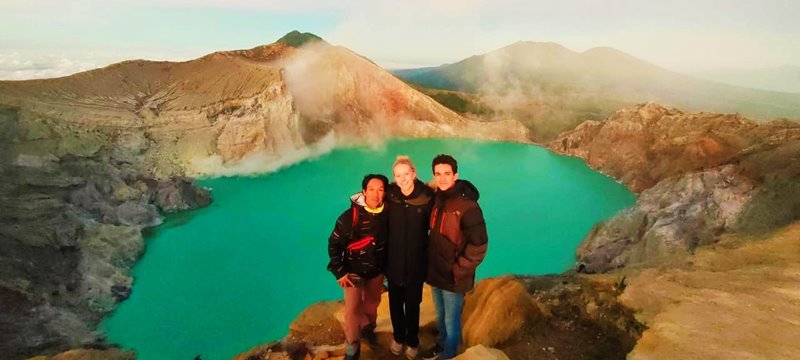
Have you ever witnessed the dazzling electric blue (neon blue) flames?, flowing slowly down the mountain at night, as well as a turquoise (sapphire blue) lake, a lake with a calm water surface, but very toxic. Not to mention the charm of the mountain mist that covers its peak at sunrise, which will make you marvel at the various shades of pink and purple as the background color. The Only One in Indonesia, Its About Mount Ijen crater.
 The Ijen volcanic complex is a collection of composite volcanoes that is situated in East Java, Indonesia, between the Banyuwangi and Bondowoso Regencies. Blue flames, an acidic crater lake, and labor-intensive sulfur mining are some of its famous features for the adventure and nature lover.
It is located within the bigger caldera named Ijen, which has a width of around 20 kilometers (12 miles). The tallest point of that complex is the stratovolcano known as Gunung Merapi.
The Indonesian word “Gunung Merapi” literally translates to “mountain of fire”; Mount Merapi in central Java and Marapi in Sumatra share the same derivation.

The Ijen volcano, which is located west of Gunung Merapi, contains an acidic crater lake that is one kilometer wide (0.62 mi), turquoise in color. A labor-intensive sulfur mining facility is located near the lake, where sulfur-filled baskets are manually transported from the crater bottom.
Considering the expense of living in the area, the work is quite demanding yet pays well. Workers are paid roughly US$13 per day, and after leaving the crater, they still have to travel about three kilometers to the adjacent Paltuding Valley to get payment for their loads of sulfur pieces.
Paltuding is the present post is the main entrance for Hiker who want clim to Ijen Crater.
The caldera and its rim are home to a large number of other post-caldera cones and craters. The majority of the post-caldera cones are located on the caldera’s southern flank, running east to west.
Kawah Ijen’s active crater has a surface size of 0.41 square kilometers and a diameter of 722 meters (2,369 feet) (0.16 sq mi). Its depth is 200 meters (660 feet), and its volume is 36 hectometers (29,000 acre-feet).

The lake is known as the world’s biggest, most acidic crater lake. Additionally, it serves as a source for the river Banyupahit, whose very acidic and metal-rich water has a negative impact on the environment of the river downstream.
A 2001 research mission determined that the lake’s pH was about 0.3. Explorer George Kourounis measured the acidity of the acid lake during the nights of July 14 and 15, 2008. Due to a high concentration of sulfuric acid, the pH of the water was determined to be 0.5 along the lake’s shores and 0.13 in the centre of the lake.

What the interesting things about Ijen?
1.Blue fire crater
Tourist numbers have surged when National Geographic published an article about Ijen’s electric-blue flame. However, midnight hiking trips are a more modern presentation of the long-known phenomena. To get to the crater’s rim, it takes two hours of hiking; from there, it takes another 45 minutes to go to the crater’s bank.
Sulfuric gas, which can burn at temperatures of up to 600 °C (1,112 °F), is what causes the blue flames. Some of the gas condenses to liquid and is still ignited, causing the flames to reach heights of up to five meters (16 feet).
The world’s largest blue flame region is Ijen. It is referred known as Api Biru by locals (Blue Fire). The second site where blue flames is visible is in Dallol mountain, Ethiopia.
2. Sulfur Mining at Ijen
 A mining activity is supported by an active vent that produces elemental sulfur near the lake’s edge. Exhausting volcanic gases are sent via a system of ceramic pipes, which causes molten sulfur to condense.
The molten sulfur, which has a bright yellow color when it is cool, drips gently from the ends of these pipes and pools on the ground. The cooled material is broken up into huge pieces by the miners, who then transport it in baskets. At a gradient of 45 to 60 degrees, miners carry cargoes weighing between 75 and 90 kilograms (165 and 198 lb) up 300 metres (980 ft) to the crater rim, then 3 kilometers (1.9 mi) down the mountain for weighing. many miners make this tiring journey twice a day.
The miners are paid by the weight of sulfur transferred to a nearby sulfur refinery; as of September 2010, the average daily wage was comparable to around $13 US. While working near the volcano, the miners frequently don’t have enough protection, and they frequently get respiratory problems. 200 miners produce 14 tons of ore daily, or around 20% of the continuous daily deposit.
Important Equipment To Bring For Climbing Mount Ijen.
- Flashlight (hand lamp or headlamp) or carry both as a spare. Using a headlamp your climbing will be easier because your hands are free to move
- Gloves, to withstand the cold weather above the Ijen caldera. Gloves also help you well when descending the crater and having to hold on to sharp wood or rocks
- Warm clothes, you should prepare in advance before leaving. During a trekking trip, you may not need it because body heat helps warm the body, but when you stay at the peak for 1-2 hours, the cold will be more colder.
- A gas mask, which you need as protection against dense clouds of toxic gases like sulfur dioxide. You can’t last long in the gas without a special mask. The presence of gas depends on the wind which sometimes you can’t avoid.
- Ordinary protective masks (health masks) and Handy Sanitizers have become an obligation and a requirement to carry, especially when entering the new adaptation era of the COVID-19 pandemic.
- Before the adaptation era occurred, some people wore them on trips but there were also those who used them when they started to smell a very strong sulfur smell. But in the new adaptation era, the importance of using health masks is precisely to have additional functions, namely to prevent the transmission of COVID 19, and to take responsibility for maintaining health among visitors to the Ijen crater.
READ MORE ABOUT MOUNT IJEN HIKING COMPLETE GUIDE INFORMATION – Klick Here.
If you plane for Mount Ijen Hiking Tou start from Bali, You can do it in 24 Hours trip.
For More information about 24 Hours Ijen Crater trip from Bali, Please click Here.